Biostatistics and Model-Informed Drug Development
Biostatistics underpins every stage of drug development, from study design through regulatory submission.
We deliver traditional statistical services while integrating biostatistics with modeling, biosimulation, and real-time data insights. As part of our unified drug development platform, this approach enables you to make better-informed decisions earlier and progress efficiently from first-in-human through proof of concept (POC).
Statistical and Modeling Solutions for Early-Phase Drug Development
Altasciences’ biostatistics and model-informed drug development (MIDD) capabilities can help you design smarter studies, reduce risk, and accelerate critical decisions.
By embedding modeling insights directly into study design and execution, we help you:
- Establish proof of mechanism earlier
- Optimize study design and endpoint selection
- Refine dosing strategies
- Make confident go or no-go decisions
- Reduce uncertainty related to PK, safety, and translational outcomes
- Enable efficient, adaptive study designs
- Support dose escalation and cohort progression
- Integrate PK/PD and biomarker endpoints
- Deliver timely interim analyses
Our experienced biostatisticians and statistical programmers are committed to meeting your timelines and supporting you throughout the development lifecycle. Working closely with our data management and medical writing teams, we ensure data is captured, analyzed, and translated into clear, actionable evidence to empower confident decision-making at every stage of your clinical program.
Clinical Trial Biostatistics Solution
Biostatistics and statistical programming are central to every clinical study, informing robust study design, and guiding study conduct, and driving high-quality data collection, analysis, and reporting.
Working as a true extension of your team, we generate meaningful data that supports confident progression through proof of concept.
Study Design and Set-Up
Our team will work closely with you to develop efficient, scientifically sound study designs that align with development objectives, maximize data quality, and support future regulatory submissions.
- Study design and endpoint strategy
- Perform sample size estimation and power analysis
- Design and implement randomization schemes
- Case report form (CRF) design aligned with CDASH standards
- Optimize study design using model-informed approaches
Analysis Planning
We ensure data is collected, structured, and analyzed consistently throughout the study and develop clear statistical frameworks that support accurate interpretation of results and minimize downstream risks.
- Develop statistical analysis plans (SAPs)
- Generate mock tables, listings, and figures (TLFs)
- Define analysis of populations and derived datasets
- Integrate modeling outputs into analysis strategy
Data Analysis, Study Execution, and Reporting
As studies progress, our biostatistics and statistical programming teams provide ongoing support to monitor data quality, generate actionable insights, and deliver reliable analyses that inform critical development decisions.
- Conduct ongoing data review and collaborative data review sessions
- Interim analysis to support study decisions
- Develop validated SAS® programs and outputs
- Advanced statistical analyses and derived datasets
- Efficient progression through database lock and reporting
Submission-Ready Deliverables
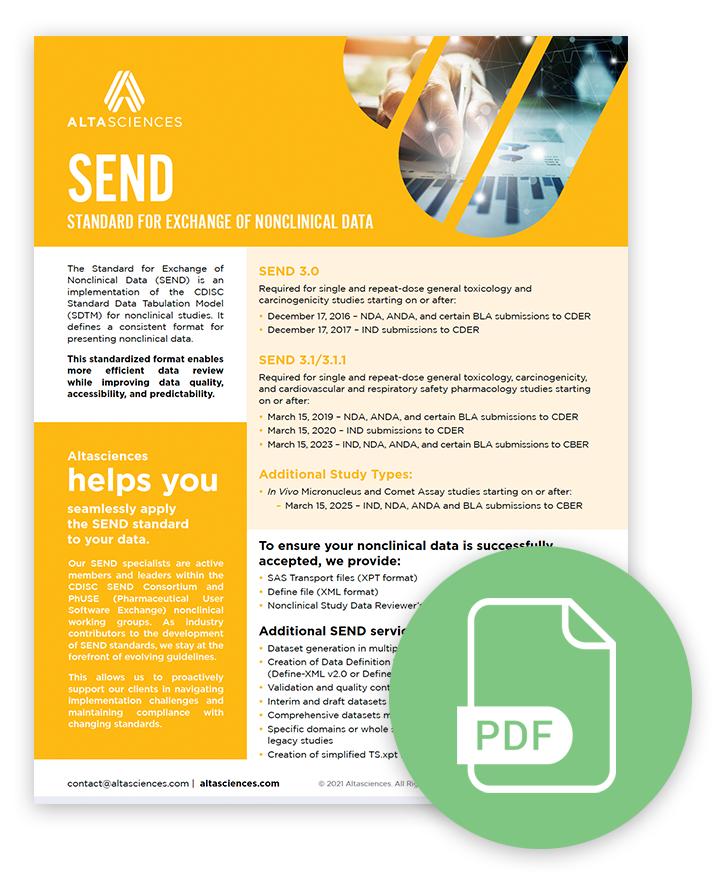
We deliver high-quality statistical outputs and CDISC-compliant packages that help streamline interactions with health authorities and support successful regulatory submissions.
- Produce Clinical Data Interchange Standards Consortium (CDISC)-compliant datasets (SDTM, ADaM)
- Conduct Pinnacle 21 validation and compliance
- Prepare and deliver complete, regulatory submission-ready packages (TLFs, define.xml/.pdf, aCRF, reviewers’ guides)
Altasciences is an active member and registered solutions provider for CDISC. We stay ahead of industry standards, applying CDISC data principles to enhance the quality of clinical research.
Consult the issue of The Altascientist that explores CDISC data standards.
Integrated Data. Reduced Complexity. Faster Outcomes
Biostatistics serves as a critical link between multiple functional areas throughout clinical development.
Our biostatisticians work closely with teams across Altasciences through:
- Collaboration with data management teams ensure data is collected, cleaned, and structured appropriately for analysis.
- Partnering with pharmacokinetic/pharmacodynamic (PK/PD) scientists supports dose selection and exposure-response evaluations.
- Working alongside medical writers to translate complex statistical results into clear, submission-ready reports.
- Coordinating with clinical operations teams to align study execution with protocol objectives and analytical requirements.
Whether you require standalone biostatistics and statistical programming support or fully integrated services as part of a broader clinical development program, Altasciences provides the expertise, flexibility, and scalability to support your study objectives at every stage of development.
Explore Altasciences’ Full Range of Supporting CRO Services
Related Resources
FAQs
How can biostatistics improve the success of my clinical study?
Biostatistics plays a critical role in ensuring studies are designed to answer the right scientific and regulatory questions. Through appropriate endpoint selection, sample size estimation, randomization strategies, and analysis planning, biostatistics helps maximize data quality, reduce development risk, and generate meaningful evidence to support informed decision-making throughout the study lifecycle.
What are the benefits of integrating biostatistics with model-informed drug development (MIDD)?
Combining biostatistics with modeling and simulation provides deeper insight into study outcomes and future development scenarios. This integrated approach can help optimize study designs, refine dosing strategies, support adaptive trial designs, evaluate exposure-response relationships, and improve confidence in go/no-go decisions, particularly during early-phase development.
How can biostatistics support dose selection and dose escalation decisions?
Biostatistical analyses, combined with PK/PD and modeling data, help sponsors understand the relationship between drug exposure, safety, and biological activity. These insights can support dose escalation decisions, cohort progression, dose optimization, and the identification of appropriate dosing regimens for future studies.
How do biostatistics services help accelerate development timelines?
Early involvement of biostatistics teams helps ensure studies are designed efficiently and data is analyzed as it becomes available. Activities such as interim analyses, ongoing data review, and integrated statistical planning can support faster decision-making, reduce delays associated with protocol amendments or data issues, and help programs progress more efficiently toward clinical proof-of-concept.
How does biostatistics support regulatory submissions?
Biostatistics teams are responsible for developing many of the key deliverables required for regulatory review, including statistical analysis plans (SAPs), tables, listings, and figures (TLFs), CDISC-compliant datasets (SDTM and ADaM), and submission-ready documentation. Working with experienced biostatistics and statistical programming teams helps ensure data quality, compliance with regulatory expectations, and efficient preparation for agency submissions.